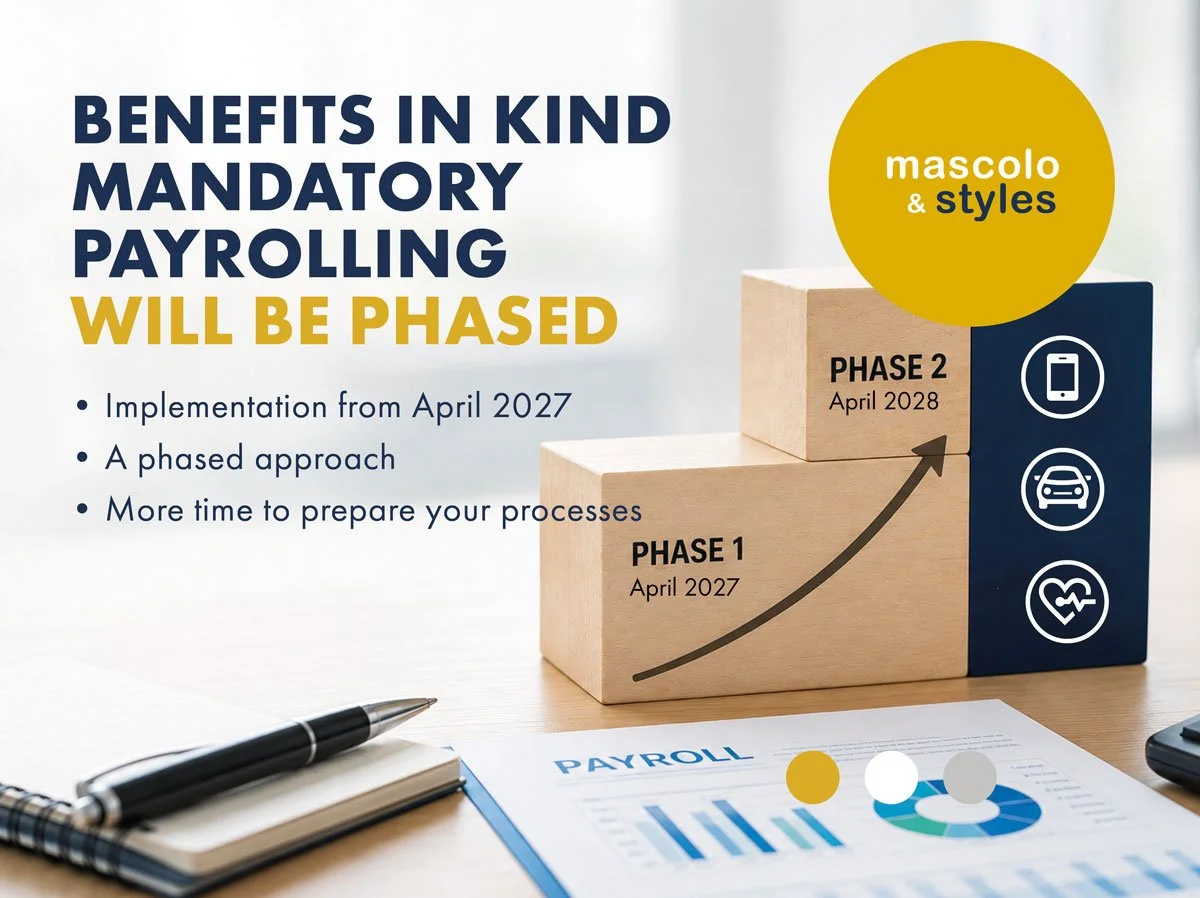
Government Confirms Phased Approach to Mandatory Payrolling of Benefits in Kind
The government has announced that mandatory payrolling of Benefits in Kind (BIK) will be introduced in two phases, shifting away from a single, simultaneous rollout originally planned for April 2027, with most benefits requiring real-time payroll reporting by 2028.
The move follows sustained feedback from employers, payroll professionals and software developers, who had raised concerns about the scale and pace of the original proposals. HMRC had initially intended for almost all benefits in kind, with limited exceptions such as employment-related loans and living accommodation, to become mandatorily payrolled from April 2027. Following delays in publishing the detailed technical guidance needed to support that timetable, the government has now confirmed a more gradual, two-phase rollout.
What is changing?
Under the new payrolling regime, the taxable value of benefits in kind will be reported through the Full Payment Submission (FPS), allowing Income Tax and Class 1A National Insurance contributions to be collected in real time through the payroll, rather than being reported after the end of the tax year via the traditional P11D process.
The two phases
Phase One - from 6 April 2027
Mandatory payrolling will apply to a limited set of benefits:
Company cars
Car fuel
Vans
Van fuel
Employer-provided medical (and dental) benefits
Employers will be required to report Income Tax and Class 1A NICs on these benefits through the payroll using Real Time Information (RTI).
Phase Two - from 6 April 2028
Most other benefits in kind will move into mandatory payrolling, including items such as gym memberships, non-cash vouchers and mobile phones falling outside the exemption. Employment-related loans and living accommodation will remain outside mandatory payrolling and will continue to be reported voluntarily.
Why the change?
HMRC says the phased approach will give employers and payroll software providers more time to adapt their systems and processes. As part of the revised plan, the number of RTI data fields required has also been significantly reduced, which HMRC says will simplify implementation for both developers and employers.
The regulator has also confirmed that employers will not need to register with HMRC in advance for benefits falling within the mandatory regime. However, employers wishing to voluntarily payroll benefits not covered by Phase One during the 2027/28 tax year are encouraged to register in good time.
What happens next?
July 2026: Updated interim guidance for employers, payroll professionals, software developers and tax agents is due to be published.
Autumn 2026: Revised technical specifications for the phased approach, along with confirmed RTI data fields for Phase One, are expected to be issued, timed to align with the Autumn Budget 2026.
2027: Further RTI specifications for Phase Two will be published as HMRC continues to work with software developers.
The reaction
The revised, phased timetable has been broadly welcomed by professional bodies and industry commentators, who see it as a pragmatic response to concerns about employers' readiness. Even so, advisers are urging businesses not to be lulled into a false sense of security by the extra time on offer.
What employers should do now
Although Phase One does not take effect until April 2027, employers are being advised to use the intervening period to:
Review current payroll processes and systems' readiness for real-time reporting of benefits
Audit which benefits they provide and map these against Phase One and Phase Two categories
Consider whether to register to voluntarily payroll benefits outside Phase One ahead of the 2027/28 tax year
Engage with payroll software providers on system updates required to support RTI reporting of benefits
Mascolo & Styles will continue to monitor developments as further guidance is published and will provide updates as the phased implementation approaches.